A Beagle doesn't run away because they don't love you. They run away because centuries of breeding have taught them to follow a scent and never stop. Recall is one of the hardest training disciplines for scenthounds—and at the same time, the most crucial for their safety. How to tackle it, what the research says, and why patience and high-value treats pay off.

Why It Is So Difficult with a Beagle
The Beagle was bred for pack hare hunting: to track scents persistently, vocally, and independently, even when the hunter is out of sight. The trait that owners today call "stubbornness" was carefully selected for generations as an asset. A dog that looked back at its handler every few meters while on a scent was not a good hound.
So when a Beagle catches an interesting scent, it is not defiance. At that moment, its brain is entirely occupied with what it was born to do. Your "come" has to compete with something that is an immensely powerful reward in itself. That is why a Beagle's recall doesn't just happen on its own; it is built—systematically, over months, and sometimes years.
What the Research Says: Reward Works Better Than Punishment
In 2020, a study by Lucy China, Daniel Mills, and Jonathan Cooper from the University of Lincoln was published in Frontiers in Veterinary Science. They tracked 63 dogs that had recall issues (and often chased livestock). The dogs were divided into three groups of 21: one trained by trainers using electronic collars, the second by the same trainers without them, and the third by independent trainers focused on positive reinforcement.
The result: the group trained with rewards responded to the "come" command more often on the first call and faster than the electronic collar group. According to a summary in New Scientist, an average of 82% of dogs in the "reward" group returned after the first command, compared to 71% in the e-collar group. The authors concluded that they found no evidence that training with an electronic collar is necessary, even for recall, which is its most frequently cited justification.
For the sake of completeness: the study also has critics (a commentary in the same journal from 2021 questions some methodological steps), so let's not take it as the final word. However, together with other research, it points in a clear direction – motivation is a stronger tool than fear. And with a Beagle, which is notoriously "food-driven," we literally have motivation at our fingertips.
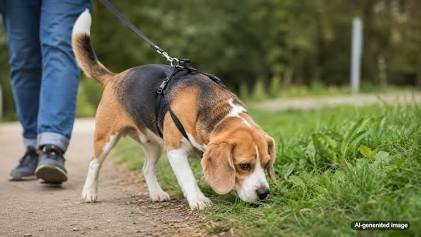
Five principles it is built on
The cue must have value
Choose one word (or a whistle) and use it exclusively for recall. If you've already repeated "come" a hundred times with no result, feel free to start fresh with a completely new word. Every cue that your dog ignores without consequence weakens the signal.
Pay with the best currency
Regular kibble from a bowl won't cut it. Recall calls for the absolute best: pieces of boiled chicken, cheese, liver, or treat paste in a tube. Ideally, use a reward your dog never gets at any other time. And don't be afraid to reward generously – several treats in a row or a brief game will turn coming back into an experience, not just a transaction. (Count the rewards toward their daily food allowance – Beagles and excess weight are a whole chapter of their own.)
Only call when you can win
The most common mistake: calling a dog that is already "in the zone" on a scent trail. At that point, you will lose, and the dog learns that the command can be ignored. Call when the dog is only sniffing lightly, is nearby, or is just glancing back at you. If you are not sure they will come, do not call—go get them.
Returning must never mean anything unpleasant
A dog that came back after ten minutes gets the same celebration as a dog that came back right away. Punishing a dog upon their return teaches them only one thing: that coming back doesn't pay off. Likewise, do not call your dog just to clip their nails, bathe them, or end the walk.
Returning doesn't mean the end of the fun
Recall, reward – and send the dog back to sniff ("go!"). This way, the dog learns that coming to you does not mean the end of freedom, but often just a quick stop with a bonus. In dog training, this is known as the Premack Principle: a high-probability behavior (sniffing) serves as a reward for a lower-probability one (returning).
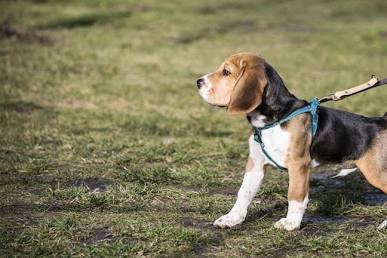
Step-by-Step Guide
At home, without distractions. Say the cue, reward. Repeat multiple times a day in short sessions. Then take a few steps back.
Garden or fenced area. Increase distance, introduce mild distractions. If the dog doesn't come, don't call again – take a step back.
Long training lead (long line). A ten-meter or longer leash is the most valuable tool for scenthounds. The dog has the freedom to sniff, but cannot "practice" running away. If they don't respond to the cue, gently guide them back to you and reward them.
Gradually more challenging environments. A quiet park, then areas with more scents, and finally environments with other dogs or wildlife. Months, not days.
Reward spontaneous check-ins. Whenever the dog turns back or runs up to you on their own during a walk, it's a golden moment for a reward. These "check-ins" are the foundation of a reliable recall.
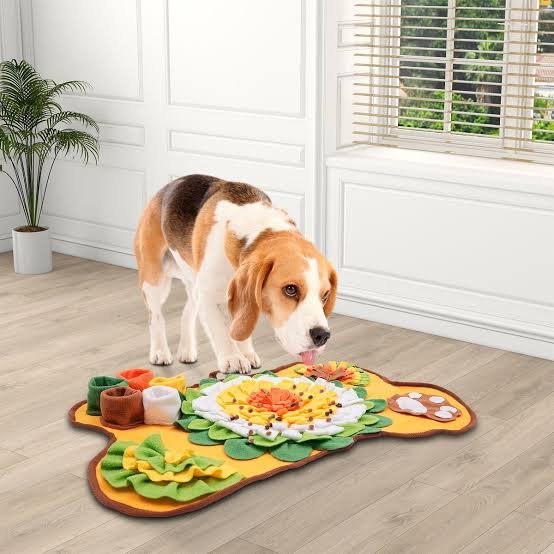
Give that nose a job
A Beagle that gets daily nosework has less need to seek it out on their own. Scent games, searching for treats in the grass, short tracking in the garden—all of this reinforces the bond that "the best things happen with me." (We wrote more about scent work in our article on scent work and mental fatigue.)
Let's be realistic
Let's face it: not every Beagle will have a recall reliable enough to run off-leash in a forest full of game. And that's okay. A reliable recall is the goal, but safety is the priority. Running free makes the most sense mainly in fenced areas or in an environment you know well. In the forest and near roads, a long line is a sign of responsibility, not failure. Also remember that a dog chasing wildlife outdoors endangers the game as well as itself, and the owner is held responsible.
A Beagle's recall isn't a command they "either know or don't know". It's a relationship built on every walk. And when you finally see your Beagle pull away from an enticing scent and run back to you with floppy ears flapping, you'll know that every single piece of chicken was worth it.
Sources
China L., Mills D. S., Cooper J. J. (2020): Efficacy of Dog Training With and Without Remote Electronic Collars vs. a Focus on Positive Reinforcement. Frontiers in Veterinary Science 7:508.
New Scientist (2020): Treats are better than electric shocks for training badly behaved dogs.
Commentary (2021), Frontiers in Veterinary Science.
Spirit Dog Training – How to Train a Beagle.
TerrierBeagleLab – Teaching Recall to Hound Dogs.